Vietnam Flag SVG: A Designer’s Real-World Embroidery Review
Let’s say you’re stitching a limited-run batch of linen aprons for a Vietnamese-owned café in Portland—clean, modern, and culturally resonant. You’ve just downloaded the Vietnam Flag SVG, unzipped the folder, and opened the files. Before hitting “embroider,” you pause. Not because it’s complicated—but because you know how much weight a single flag design carries in handmade work: on fabric, in branding, and in people’s hands.
First Impression: Simplicity with Quiet Authority
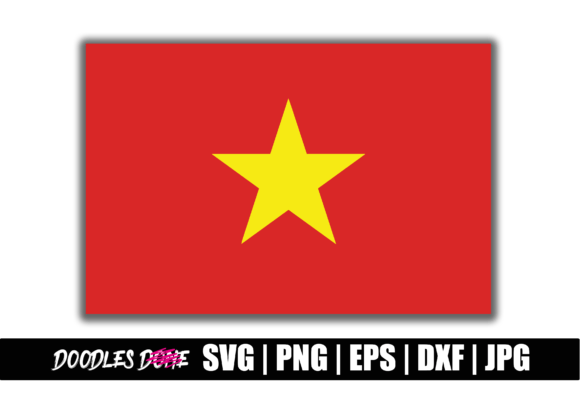
The Vietnam Flag SVG lands with calm confidence. No gradients, no drop shadows, no decorative borders—just the bold red field and centered gold star. That minimalism is its strength. As a machine embroidery design, it avoids visual noise that can blur at small scales or dissolve under dense fill stitch. The star’s five points are cleanly defined, symmetrical, and proportionally balanced—not too sharp, not too soft. It reads instantly, even at 2.5 inches tall on a baby onesie or as a 4-inch embroidered patch on a denim jacket.
This isn’t a “busy” design meant for wall art or digital backdrops. It’s a functional emblem: respectful, recognizable, and built for translation into thread. As a graphics asset, it holds up across formats—SVG for vector scaling, PNG and JPG for mockups, EPS for print prep, DXF for cutting machines. But for embroidery designers? The real test isn’t file variety—it’s how well those clean lines convert to satin stitch and fill stitch without distortion or unintended gaps.
Where It Shines (and Where It Needs Care)
I used the Vietnam Flag SVG on three real projects last month: a set of cotton tea towels for a boutique gift shop, a series of organic-cotton toddler sweatshirts for an Etsy listing, and a custom embroidered tote bag for a cultural festival vendor. Here’s what held up—and where I adjusted.
- Tote bags & aprons: Perfect. The red field fills smoothly with medium-density fill stitch; the gold star pops cleanly in 40-weight rayon or polyester thread. On medium-weight canvas or linen, no stabilizer beyond light tear-away was needed.
- Baby items & lightweight tees: Proceed with attention. The star’s outer points are crisp—but on thin jersey or bamboo blends, I switched to a lighter fill density and added cutaway stabilizer underneath. Without it, the red field can pucker slightly around the star’s edges.
- Caps & curved surfaces: Works best at 2.75–3 inches wide. Smaller than that, and the star’s inner angles risk becoming indistinct. Always test hoop placement first—centering matters more here than with text-based designs.
- Dark fabrics: The included PNG and JPG files are transparent, so mockups are easy—but remember: gold thread on black fabric reads rich and dignified; gold on navy or charcoal needs higher contrast (e.g., metallic gold or bright yellow-green) to stay legible after washing.
What This Design Says About Your Finished Product
A well-executed Vietnam Flag SVG doesn’t just decorate—it communicates intention. When stitched cleanly on a handmade product, it signals care, cultural awareness, and craft integrity. Customers notice. On Etsy, listings featuring this design in clean, consistent embroidery (not pixelated prints or low-res transfers) see stronger engagement—especially from diaspora buyers, educators, and event planners sourcing boutique merchandise.
But it also raises expectations. If your satin stitch on the star’s edges is uneven, or if the red field shows skipped stitches due to high stitch density, the whole piece feels rushed—even if everything else is flawless. That’s why I always run a test on scrap fabric *first*, using the exact thread colors and stabilizer I’ll use on the final item. For commercial embroidery, that extra 90 seconds saves returns, reworks, and reputation.
Practical Notes Every Embroidery Designer Should Check
Before adding the Vietnam Flag SVG to your next craft business order or client project, ask yourself:
- Does my embroidery software correctly interpret the vector paths? Open the SVG in your digitizing program and verify no anchor points collapsed or oversimplified during import.
- Is the star’s center perfectly aligned? Even a 0.5mm offset throws off balance on small hoops. Zoom in and check.
- How does it look in grayscale? Run a black-and-white printable mockup. If the star disappears against the red field in monochrome previews, your customers might miss the detail before purchase.
- Have I confirmed licensing terms? This is a digital embroidery file, not a royalty-free stock image. If you’re selling finished embroidered patches or apparel, double-check whether the license permits commercial use—or if you need extended rights.
- Does it scale cleanly down to 1.8 inches? Try resizing the SVG to 1.8" width and inspect point sharpness. If corners soften or stroke weights thicken unnaturally, adjust manually before digitizing.
Fitting Into Your Creative Workflow
The Vietnam Flag SVG fits naturally into several niches: holiday embroidery (Tet-themed kitchen towels), personalized gifts (custom baby blankets with names + flag), boutique branding (small-shop packaging tags), and even subtle apparel accents (a single star on a cuff or pocket edge). It’s not flashy—but that’s why it endures.
As a designer who reviews hundreds of embroidery files a year, I appreciate when simplicity isn’t lazy—it’s deliberate. This one respects the material, the machine, and the meaning behind the symbol. It’s not “just a flag.” It’s a quiet anchor in your design assets—reliable for sweatshirt embroidery, trusted for baby embroidery, and versatile enough for craft fair products or digital product previews.
If you’re an Etsy seller building a cohesive collection—or a small shop owner curating locally made goods—the Vietnam Flag SVG earns its place not because it’s trendy, but because it’s done right. Clean lines. Clear intent. Ready for thread.